
MOTS-c

PeakTides MOTS-c Research Hub
A mitochondrial-derived peptide in cellular signaling research
This hub explains what researchers have observed in cellular, animal, skeletal-muscle, and limited human-observation settings—and where that evidence stops.
Direct answer
What is MOTS-c?
MOTS-c is a mitochondrial-derived peptide studied in cellular, animal, skeletal-muscle, and limited human-observation research contexts. The cited literature supports model-specific observations about metabolic-stress and signaling research; it does not establish treatment, dosing, performance, personal-use, or universal human metabolic outcomes.
Research material links are commercial and separate from PeakTides editorial findings.
Section 1
Mitochondrial DNA → MOTS-c → cellular signaling
MOTS-c is described in the foundational literature as a peptide encoded by a short open reading frame in mitochondrial 12S rRNA. That origin makes it conceptually distinct from proteins encoded by the nuclear genome; it does not assign MOTS-c one universal function.
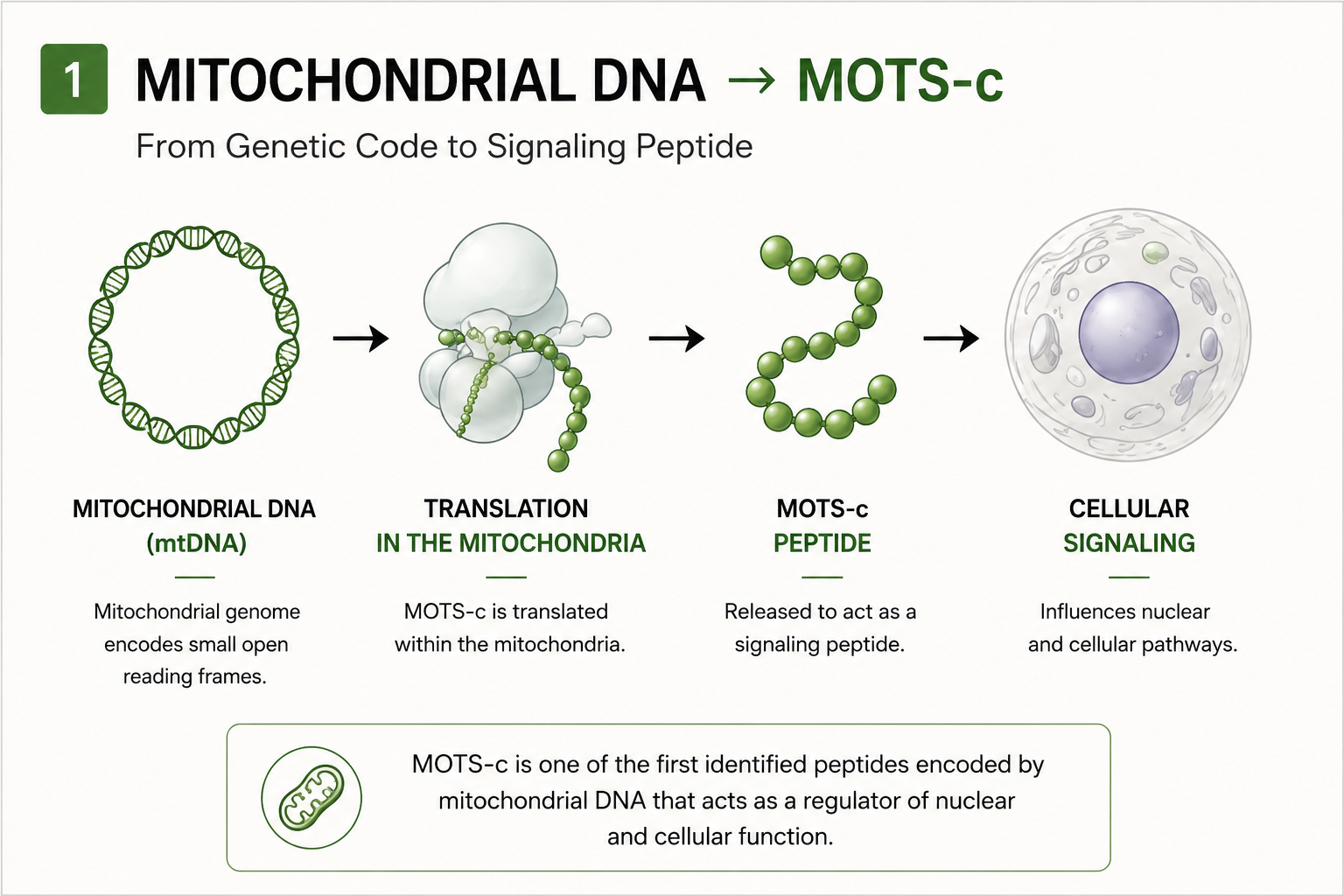
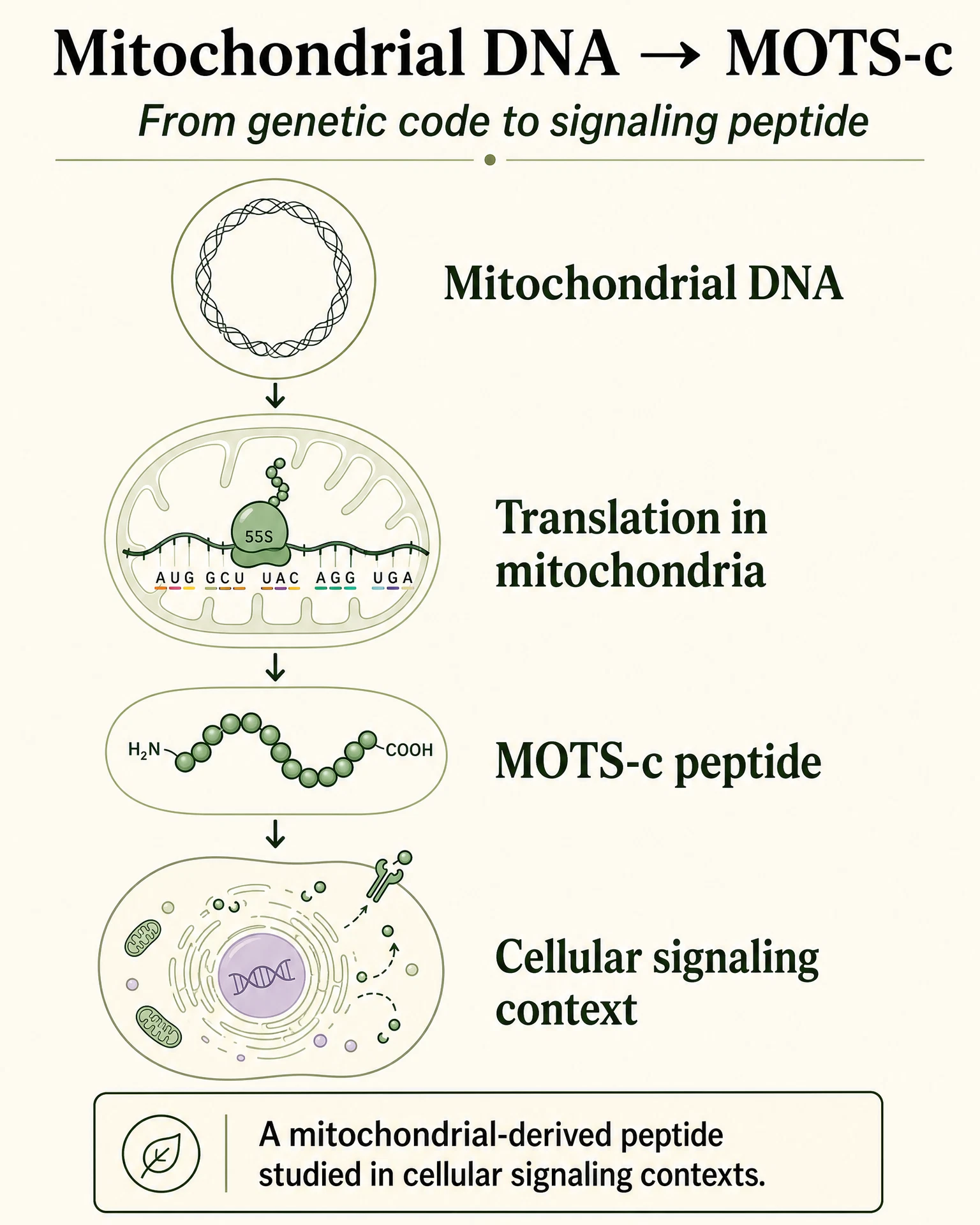
Why this became scientifically interesting: the cited primary literature provides a model-based basis for studying mitochondria–nucleus communication through peptides encoded within mitochondrial DNA. Explore the foundational source →
Section 2
Mitochondria are more than “power plants”
Mitochondria are central to energy metabolism, but research also examines them as organelles involved in stress sensing and signaling. Mitochondrial-derived peptides are one research route through which investigators study that communication.
Energy metabolism
Metabolic context
Mitochondria participate in cellular metabolism. This is context for MOTS-c research—not a claim that the peptide itself is “energy.”
Cellular stress sensing
Defined experimental conditions
Researchers have examined MOTS-c in cells exposed to defined metabolic-stress conditions.
Mitochondrial-derived peptides
Signaling research
The mitochondrial-encoding context opens a research question about communication between mitochondrial and nuclear systems.
Section 3
MOTS-c and metabolic stress
The nuclear-translocation question is one of the most specific findings in the MOTS-c record. In reported cell experiments, defined metabolic-stress conditions were associated with dynamic nuclear translocation observations.
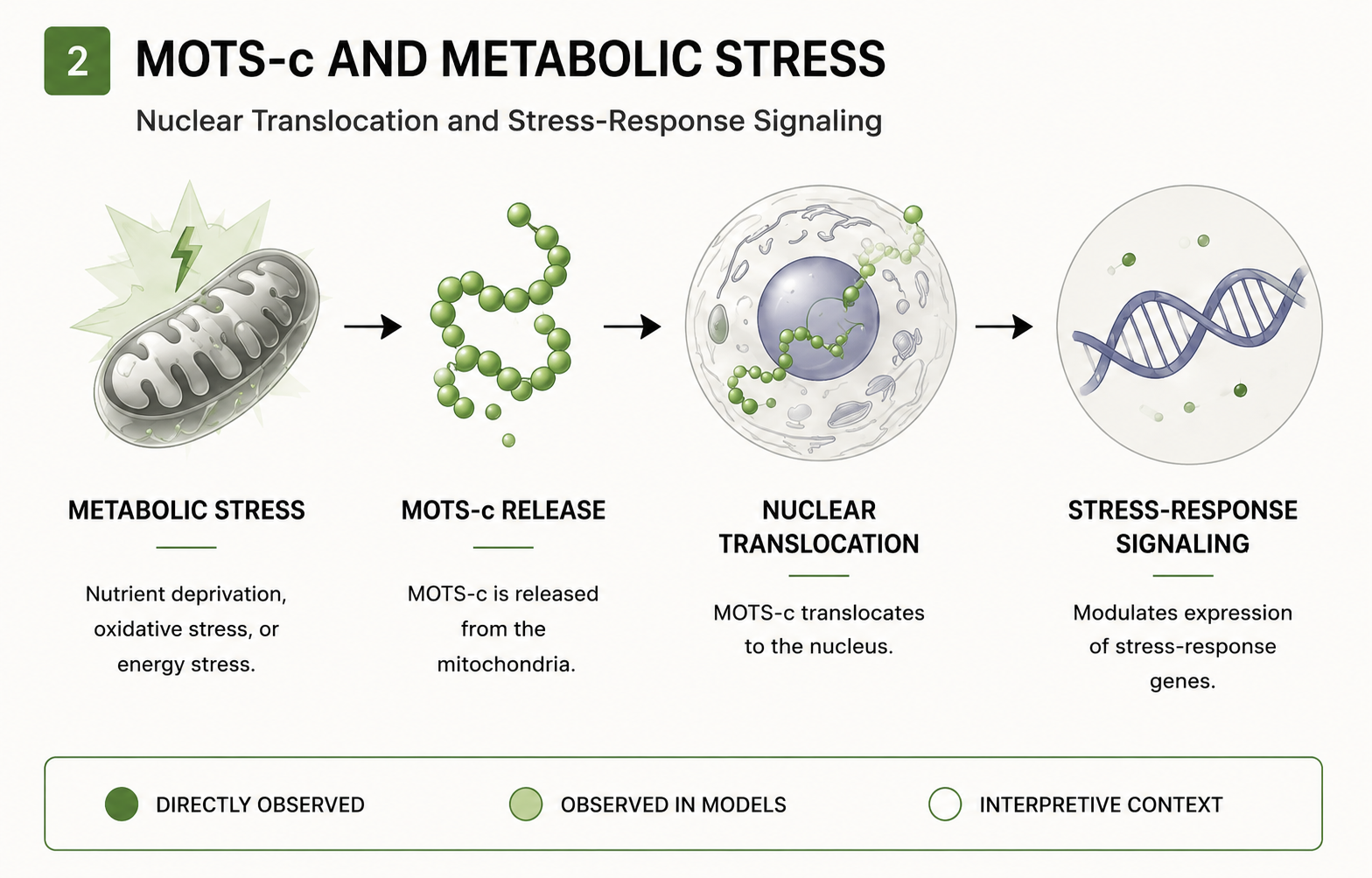
Observed in the cited cellular study: glucose restriction, serum deprivation, and oxidative-stress conditions were used to examine localization and nuclear gene-expression context. Interpretive context: these data support a model of stress-responsive mitochondrial–nuclear communication; they do not establish the same response in people. Read the 2018 Cell Metabolism study →
Section 4
MOTS-c and AMPK: a research intersection
AMPK is a kinase researchers measure in cellular energy and stress-signaling studies. The MOTS-c literature includes AMPK-related observations in defined cell and animal experiments.
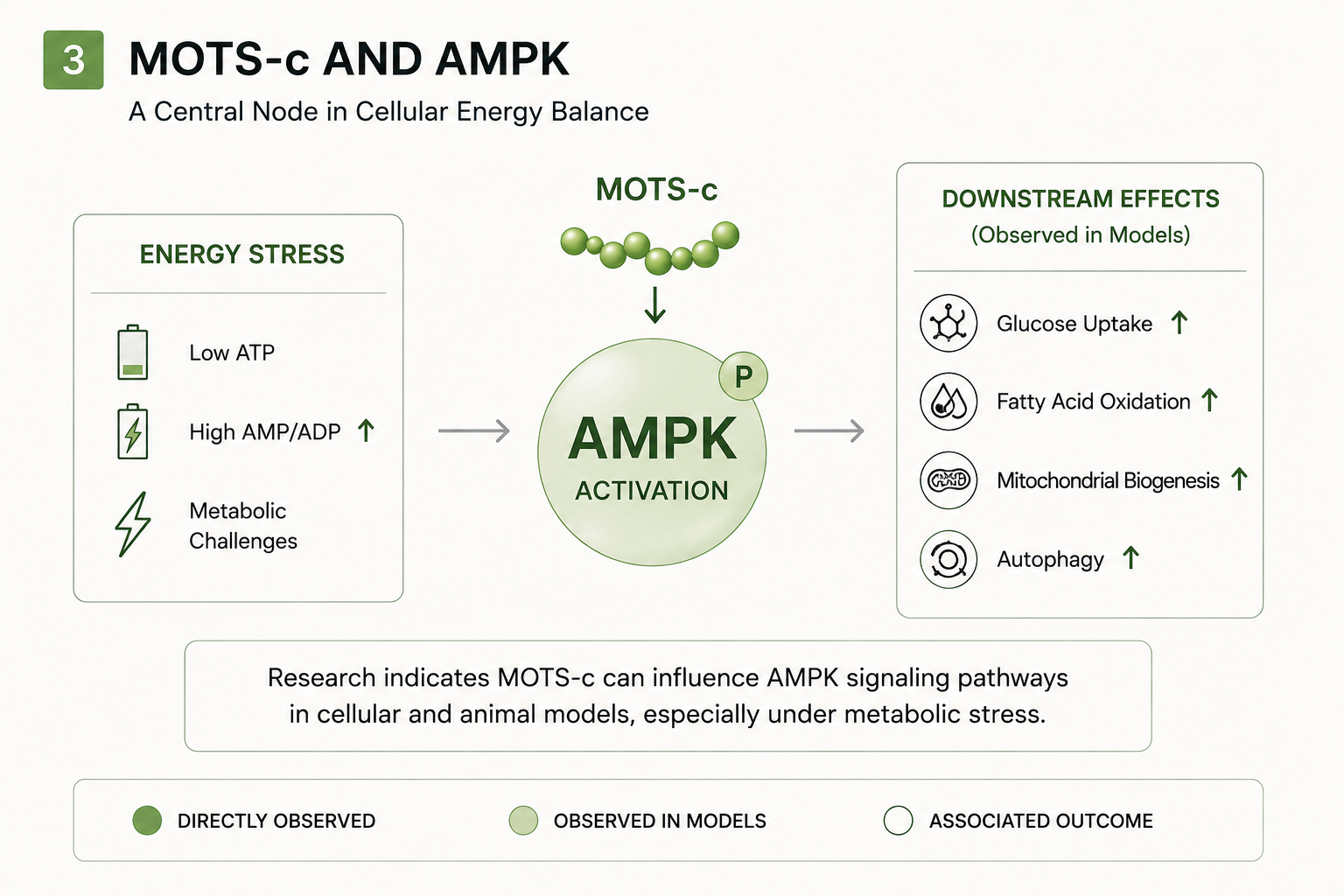
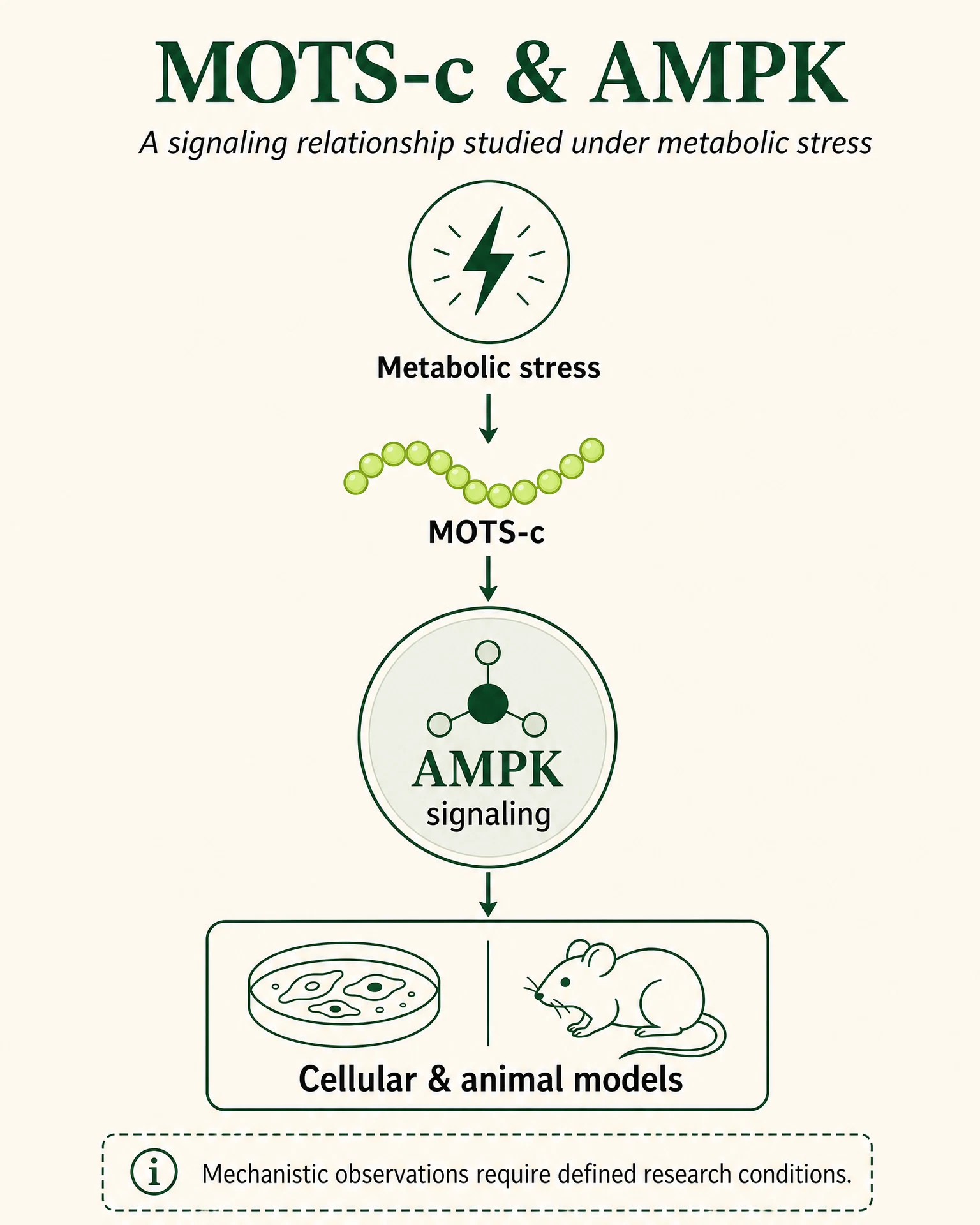
In the cited work, AMPK-related findings appear alongside cellular metabolic intermediates, stress signaling, and skeletal-muscle model questions. The appropriate reading is method- and model-specific: the papers show why researchers examine this intersection, not a universal outcome. 2015 cellular and mouse-model context → 2021 model-specific AMPK context →
Section 5
Skeletal-muscle research: separate observation from interpretation
Skeletal muscle is a recurring model context in the cited record. The evidence is more useful when the model, observation, and inference are kept distinct.
Observed in model
Cellular and animal findings
The primary studies report skeletal-muscle and myoblast observations in their stated experimental systems.
Possible interpretation
Research questions about signaling
Those observations support further research into mitochondrial-derived peptides and metabolic-stress signaling.
Not established in humans
No transfer by assumption
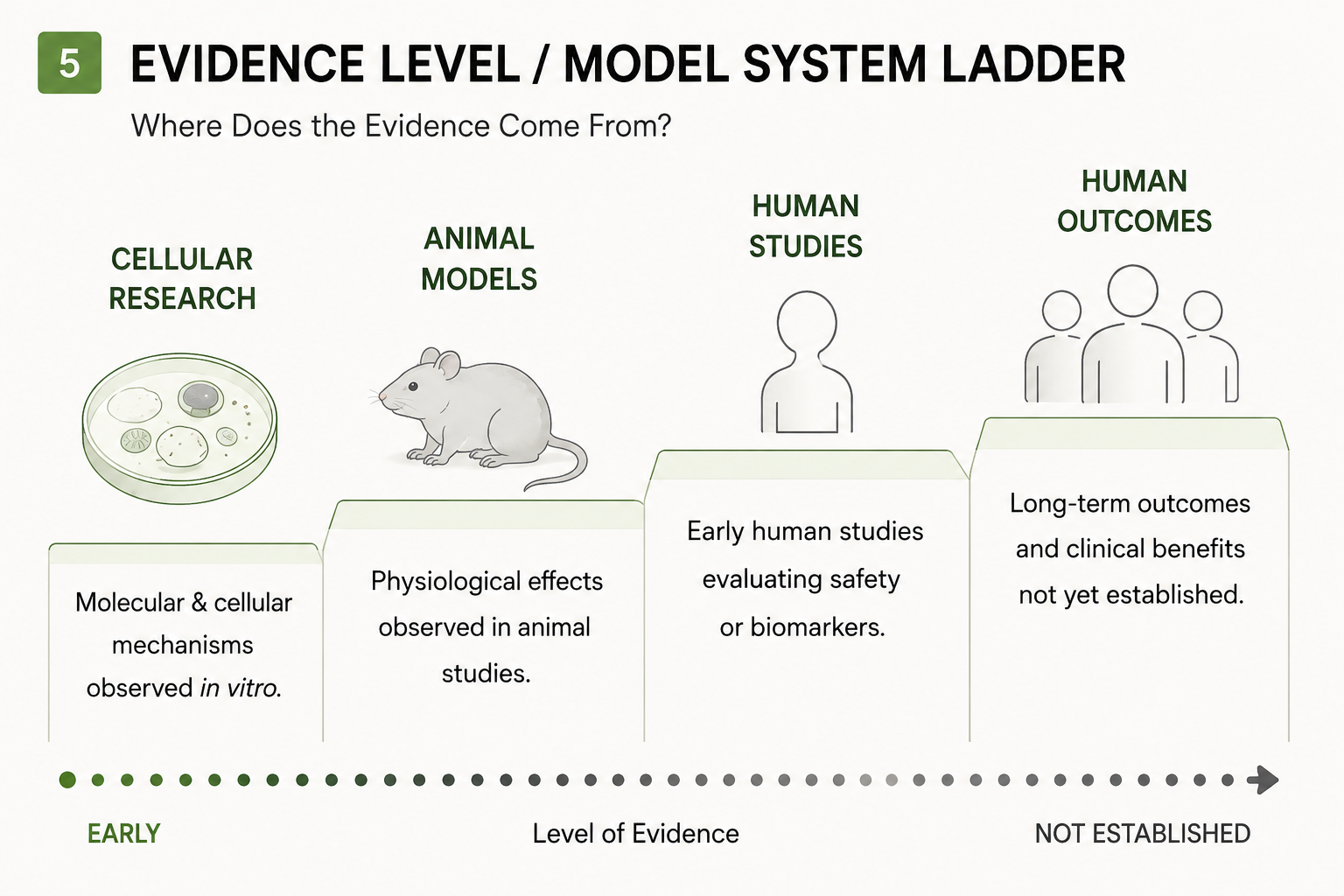
Cell and animal findings do not automatically predict a human outcome.
Limited human context: a 2021 primary study reported exercise-associated endogenous MOTS-c expression changes in skeletal muscle and circulation in its human cohort. This is an observational result and must remain separate from the same paper’s mouse and cell experiments. Read the study →
Section 6
What the evidence shows—and what it does not show
Evidence boundaries are not a disclaimer added after the fact. They are part of the research interpretation.


Current evidence can support
- Mitochondrial encoding context
- Cellular and model-system observations
- Defined metabolic-stress and signaling findings
- Limited, study-specific human observation
Current evidence does not automatically establish
- Human performance outcomes
- Treatment outcomes
- Personal-use outcomes
- Dosing recommendations
- Universal metabolic effects
Section 7
Research timeline
Milestones below link directly to the primary literature behind the page’s core concepts.
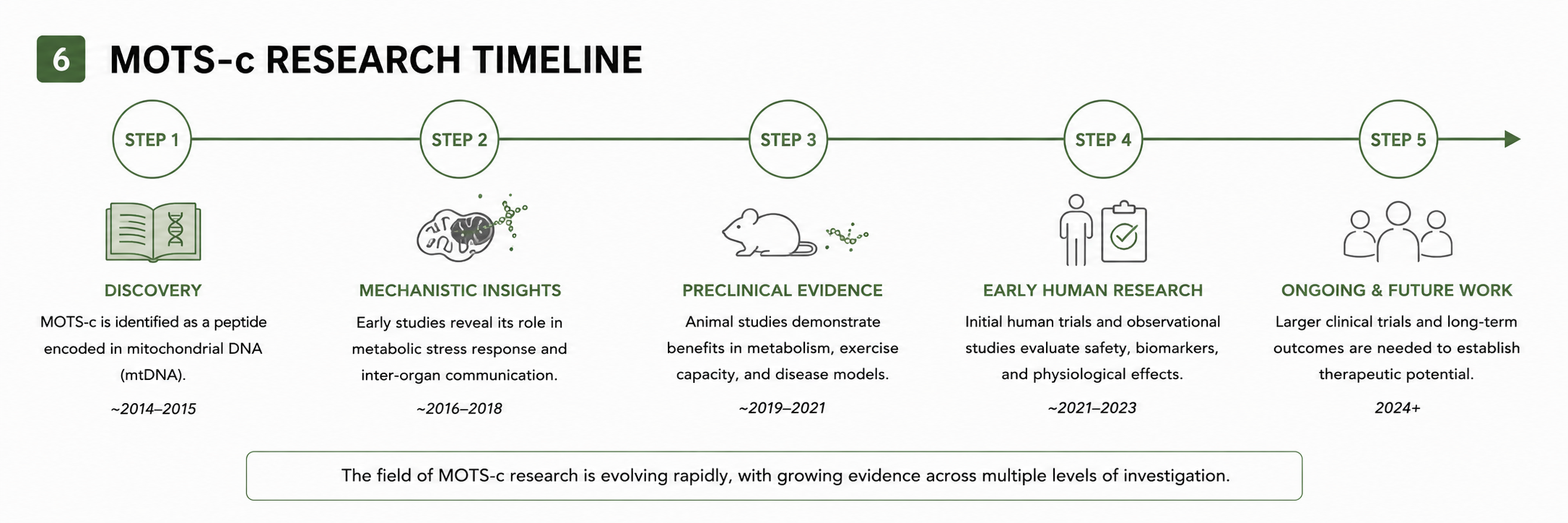
- MOTS-c described as a mitochondrial-derived peptide.
Foundational cellular and mouse-model work established mitochondrial-encoding and metabolic-research context.
Read the 2015 primary study → - Nuclear translocation examined under metabolic stress.
A Cell Metabolism study reported nuclear translocation and gene-expression observations in specified cell experiments.
Read the 2018 primary study → - Skeletal-muscle and AMPK-related model research expanded.
Primary papers added model-specific skeletal-muscle, AMPK/PGC-1α, and limited human exercise-observation context.
Reynolds et al., 2021 →
Yang et al., 2021 →
Research FAQ
Questions the evidence can answer—carefully
These visible answers are source-bounded. FAQ structured data is intentionally not added because this educational research page is not the type of site currently prioritized for FAQ rich results.
01What is MOTS-c?
MOTS-c is described in the cited literature as a mitochondrial-derived peptide encoded by a short open reading frame in mitochondrial 12S rRNA. Its research context and observed effects depend on the specific model and experiment.
02Is MOTS-c produced by mitochondria?
The foundational primary study identified a mitochondrial DNA short open reading frame associated with MOTS-c. That mitochondrial-encoding context is why it is classified as a mitochondrial-derived peptide.
03What is a mitochondrial-derived peptide?
It is a peptide associated with an open reading frame in mitochondrial DNA. The term describes origin and research context; it does not assign every such peptide a single universal function.
04What does MOTS-c do in research models?
The cited cellular, mouse, and skeletal-muscle studies report model-specific metabolic and stress-linked signaling observations. Those findings should remain tied to their stated systems.
05What is AMPK?
AMPK is a kinase researchers measure in cellular energy and stress-signaling research. The MOTS-c literature discussed here includes AMPK-related observations in defined cellular and animal models.
06Why is MOTS-c studied in skeletal muscle?
Skeletal muscle appears in the cited research as a model-relevant tissue for metabolic signaling questions. That context does not establish a personal-use or performance conclusion.
07What happens to MOTS-c during metabolic stress?
In the cited 2018 cellular study, defined metabolic-stress conditions were associated with nuclear translocation observations. The evidence is cellular and condition-specific.
08Does MOTS-c enter the nucleus?
Nuclear translocation was reported in specified cell experiments under defined metabolic-stress conditions. The result should not be generalized beyond the experimental context.
09Has MOTS-c been studied in humans?
A cited 2021 study reported exercise-associated endogenous MOTS-c expression changes in skeletal muscle and circulation in its human cohort. That is an observational finding, distinct from the paper’s separate cellular and mouse experiments.
010What does current MOTS-c evidence actually establish?
Current evidence supports a mitochondrial-derived-peptide research context and selected observations in cellular, animal, and limited human observational settings. It does not automatically establish treatment, performance, dosing, or universal human metabolic outcomes.
Related PeakTides research
Explore adjacent evidence questions
These links broaden research literacy without treating separate analytical or terminology questions as proof of a MOTS-c claim.
Explore the research
Source trail and evidence context
Each source below contributes a defined part of the page. The page does not extend any source beyond its study system.
The mitochondrial-derived peptide MOTS-c promotes metabolic homeostasis
Cell and mouse-model research that must retain model-specific wording.
Read source →MOTS-c translocates to the nucleus under metabolic stress
Mechanistic study of nuclear translocation and gene regulation.
Read source →MOTS-c is an exercise-induced mitochondrial-encoded regulator of age-dependent physical decline and muscle homeostasis
Limited human exercise-associated endogenous MOTS-c observation, plus separately bounded cellular and mouse skeletal-muscle findings.
Read source →MOTS-c interacts synergistically with exercise intervention to regulate PGC-1α expression, attenuate insulin resistance and enhance glucose metabolism in mice via AMPK signaling pathway
C2C12 and mouse AMPK/PGC-1α/MOTS-c observations used only as model-specific pathway context.
Read source →